
Free Printable Word Search Puzzles for Seniors — Large Print, Daily Themes
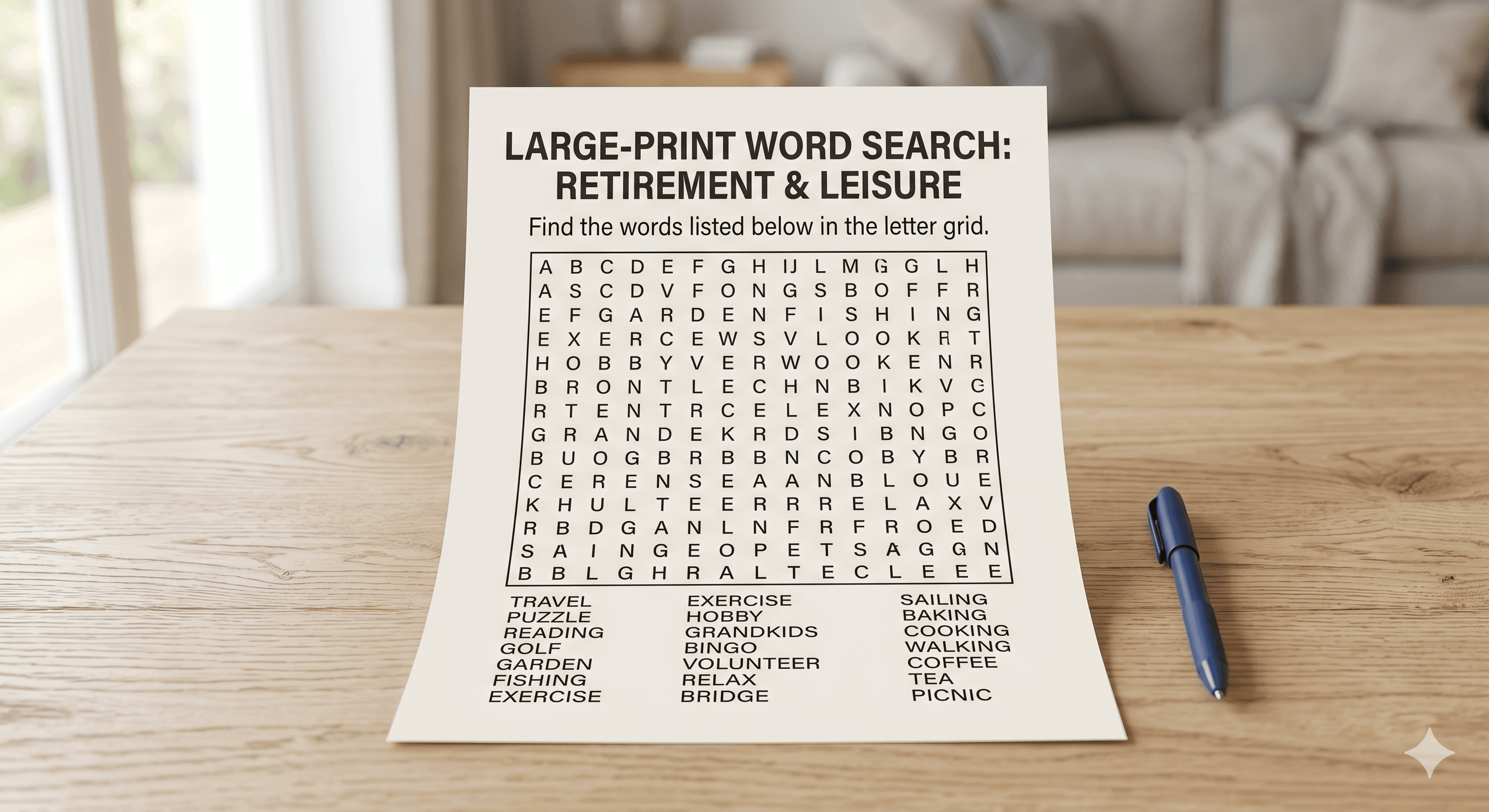
Not everyone wants to stare at a screen. For many adults — especially those over 65 — a printed puzzle on paper is simply more comfortable, more familiar, and more enjoyable than tapping a phone. Large-print word search puzzles for seniors sit at the intersection of accessibility and genuine cognitive benefit: they are easy to engage with, hard enough to be worthwhile, and calming enough to make daily practice feel like a pleasure rather than a chore.
MendMemory generates a new themed word search every single day — and every puzzle is available as a free, print-ready PDF with no sign-up required. Each puzzle is formatted with a large, clear grid and a bold word list, designed specifically for comfortable use on paper.
Download today's free word search puzzle — large print, A4 format, themed to today's date. Print it in one click.
Download Today's Free Puzzle →Why Large Print Matters
Vision changes significantly with age. By 60, most adults need roughly three times more light to see clearly than they did at 20. Contrast sensitivity — the ability to distinguish between similar shades — also declines, making small, tightly spaced text genuinely difficult to read rather than merely inconvenient. Standard word search grids, designed for book printing, typically use 8–10pt type in dense 15×15 or larger grids. For many seniors, this creates real eye strain that shortens play sessions and removes the enjoyment from what should be a relaxing activity.
A large-print format — 12pt minimum for grid letters, clear bold type for the word list, and meaningful white space between cells — removes those barriers entirely. The cognitive challenge remains; the physical frustration disappears. This is not a small distinction. Research on engagement in older adult populations consistently shows that accessibility directly predicts consistency, and consistency is what produces cognitive benefit over time.
What Makes a Good Printable Word Search for Seniors
Not all printable word searches are created equal. Many found online use overly large grids (15×15 or more) with tiny letters crammed into a standard page, a word list of 20 or more items that becomes frustrating rather than satisfying, and random word selections that feel disconnected and unmemorable. The most effective puzzles for older adults tend to use a 12×12 grid with 10 words — large enough to feel substantial, small enough to complete in 10–15 minutes. The words should follow a clear theme — garden plants, British cities, classic films — so the brain engages semantic memory alongside visual scanning. And the layout should give the grid and word list enough space to breathe on the page.
MendMemory's daily printable is designed around exactly these principles. Each puzzle uses a 12×12 grid, 10 hard-difficulty words drawn from a themed category, and a clean two-section layout: grid on top, word list below. The font is large enough to read comfortably without reading glasses for most users, and the grid cells have clear borders that make scanning straightforward.
How the Daily Printable Works
Every day at midnight UTC, MendMemory rotates to a new themed puzzle. The same puzzle is available all day — meaning a caregiver can download it in the morning, a family member can print it at lunchtime, and a care home activity coordinator can use it in an afternoon session, all from the same link. There are no accounts, no subscriptions, and no watermarks on the downloaded PDF.
You can also download puzzles for past dates by visiting the free worksheets page and selecting a specific date — useful for care homes that plan activities a week ahead, or families who want to build up a small library of printed puzzles for a parent or grandparent.
Browse the full archive of daily printable puzzles — pick any date and download instantly.
Browse All Free Worksheets →Printing Tips for the Best Result
The PDF is formatted for A4 paper (the standard in the UK, Australia, and most of Europe) but prints cleanly on US Letter as well — most printers will auto-scale slightly without any loss of readability. For the clearest result, print in black and white on plain white paper rather than recycled stock, which can reduce contrast. If the recipient has significant vision impairment, printing at 115–120% scale on A3 paper produces a genuinely large-print result with no loss of quality.
For care homes and activity coordinators printing multiple copies: the PDF has no copy restrictions and can be reproduced freely for personal and non-commercial use. Laminating a completed copy to use as a reference answer sheet is a practical approach for group sessions.
The Cognitive Benefits — Why This Is More Than Just a Pastime
A 2019 study of 17,000 adults over 50, published in the International Journal of Geriatric Psychiatry, found that regular word puzzle players had sharper short-term memory, better sustained attention, and faster processing speed — with a cognitive age difference equivalent to ten years compared to non-players. The benefits were most pronounced in adults who played consistently, at least several times per week, rather than occasionally.
Word searches in particular engage four distinct cognitive systems simultaneously: working memory (holding the word list in mind), sustained attention (scanning methodically without drifting), selective attention (filtering out irrelevant letters), and visual pattern recognition (identifying target letter sequences). This cognitive load — spread across multiple systems — is what makes word searches more than just a pleasant distraction. Done daily, they function as a genuine maintenance practice for the brain.
Ten minutes a day, printed on paper, with a cup of tea. That is a sustainable brain training habit — and sustainable is the only kind that works.
Why Daily Themes Beat Random Word Lists
Random word searches — where the word list is simply a collection of unrelated words — produce a thinner cognitive workout than themed ones. When words are grouped around a single topic, the brain must activate its semantic memory network for that category while simultaneously performing visual scanning. This dual engagement — semantic retrieval plus pattern recognition — produces measurably better outcomes in memory consolidation studies.
There is also a practical benefit for older adults: themed puzzles are more motivating. Finding the word RHUBARB in a Kitchen Garden puzzle feels more satisfying and contextually meaningful than finding it in a random assortment. For adults with early-stage memory concerns, familiarity and positive associations are not trivial — they make the difference between a habit that sticks and one that fades after a week.
Download today's themed puzzle free — no sign-up, no cost. Print it, enjoy it, come back tomorrow for a new one.
Download Today's Free Word Search →