
What Is Cognitive Reserve — And Why It's Your Brain's Best Defence Against Decline
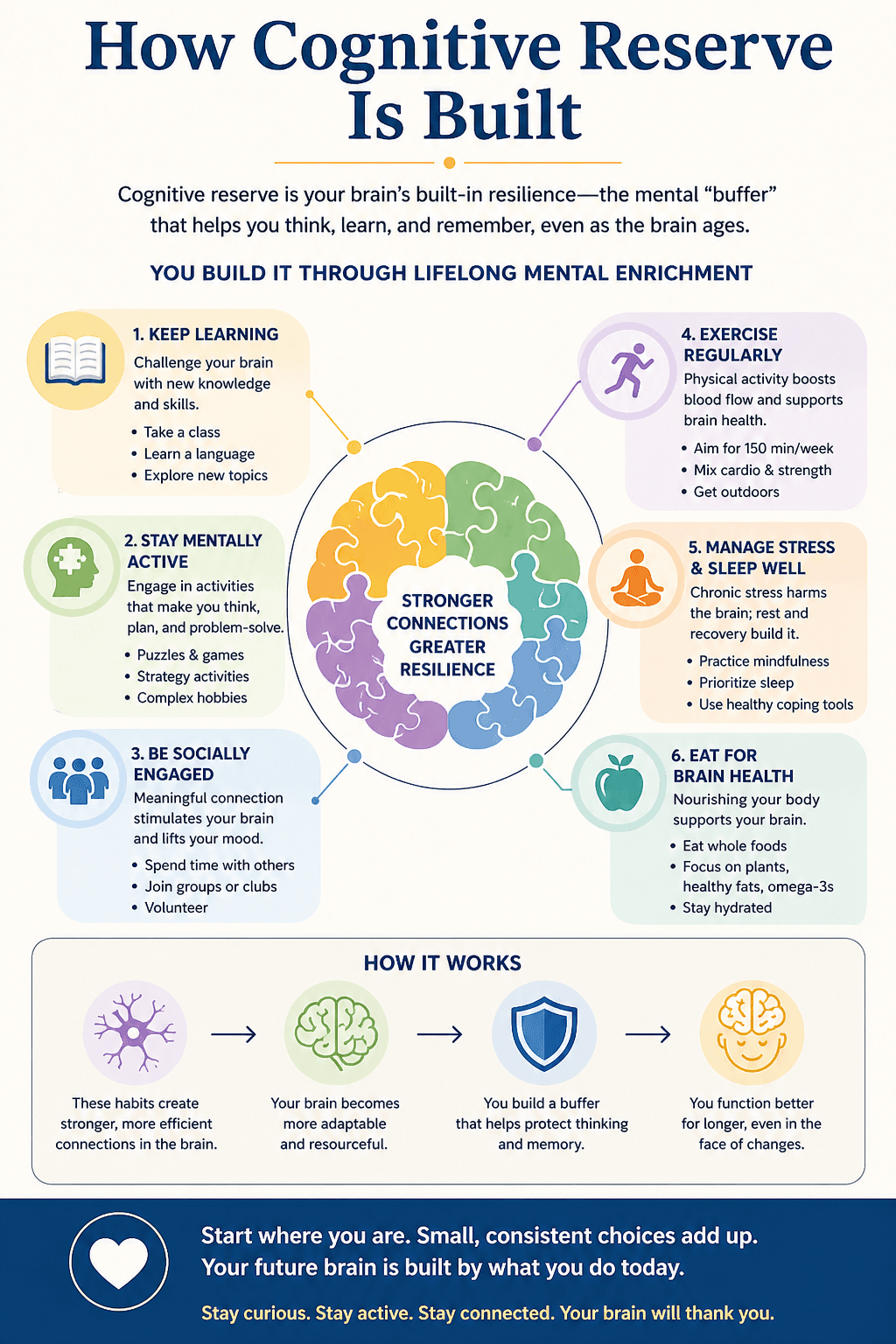
Two people can have the same amount of Alzheimer's-related pathology in their brains — the same plaques, the same tangles — and yet one experiences significant cognitive impairment while the other functions normally. This is not a medical anomaly. It is the effect of cognitive reserve: the brain's accumulated resilience against damage, built up over a lifetime of mental engagement. Understanding cognitive reserve is one of the most useful frameworks for thinking about long-term brain health — because unlike genetics, it is largely within your control.
What Cognitive Reserve Actually Is
Cognitive reserve is not a single brain structure or measurable quantity. It is a functional concept: the brain's ability to cope with damage or age-related decline by using alternative neural pathways and compensatory strategies. Think of it as the difference between a single-lane road and a motorway. When the single lane is blocked, traffic stops. When one lane of a motorway is closed, traffic reroutes. The motorway has more redundancy — more reserve.
The concept emerged from an influential 1988 study by neuroscientist Robert Katzman, who examined post-mortem brain data from a group of nursing home residents. A subset of those patients had shown no signs of dementia during their lifetimes — yet their brains displayed the full pathological signature of advanced Alzheimer's disease. What distinguished them from patients who had shown clinical symptoms was brain size and neuron count: their brains were physically larger and denser, with more synaptic connections. They had, in effect, more neural resources to lose before the loss became functionally apparent.
How Cognitive Reserve Is Built
Research over the following decades identified several consistent predictors of higher cognitive reserve. Education — particularly education that demands sustained analytical engagement — is the strongest predictor, with each additional year of formal education associated with a measurable reduction in dementia risk. Occupational complexity matters similarly: people who spend their careers in intellectually demanding roles accumulate greater reserve than those in low-complexity work. Social engagement, bilingualism, and regular mental stimulation in leisure time all contribute independently.
The common thread across all these factors is neuroplasticity: the brain's capacity to form new synaptic connections and strengthen existing ones in response to challenge. Cognitive reserve is essentially the cumulative product of neuroplasticity over time. Every intellectually demanding experience — learning something new, solving a problem, engaging with unfamiliar material — contributes a small increment to the brain's total reserve. The increments are small individually; their accumulation over decades is substantial.
Why Your 50s and 60s Are Particularly Important
Cognitive reserve can be built at any age, but the rate at which it is built — and the degree to which new habits can meaningfully offset the natural decline in neuroplasticity that comes with ageing — means that the decades between 50 and 70 represent a critical window. During this period, the brain retains meaningful neuroplastic capacity, Alzheimer's pathology is typically at an early stage (if present at all), and lifestyle interventions have the longest runway to accumulate benefit before the risks associated with advanced age become dominant.
A landmark 20-year longitudinal study published in JAMA Internal Medicine tracked over 2,000 adults from midlife into old age and found that those who engaged in at least moderate levels of cognitive activity in their 50s and 60s had a 46% lower risk of developing dementia in their 70s and 80s, independent of education, genetics, and cardiovascular health. The effect was dose-dependent: more frequent engagement produced greater protection. And critically, even adults who began regular cognitive activity in their mid-60s — having been relatively inactive before — showed meaningful protective effects compared to those who never engaged.
Build your cognitive reserve one day at a time — a free themed puzzle every day, proven to engage working memory, attention, and pattern recognition.
Play Today's Free Puzzle →What Counts as Cognitive Activity
Not all mental activity contributes equally to cognitive reserve. The activities with the strongest evidence behind them share two characteristics: novelty and challenge. Familiar, routine mental tasks — even complex ones that have become automatic — produce less neuroplastic stimulus than tasks that require genuine problem-solving or learning. This is why crossword experts who have done crosswords for thirty years show less cognitive benefit from crosswords than beginners: the task has become automated, reducing its demand on the systems that drive reserve-building.
Activities with strong evidence for cognitive reserve building include: learning a new language, playing a musical instrument (especially later in life), engaging with complex reading, regular social interaction involving discussion and debate, and puzzle activities that involve systematic problem-solving under cognitive load. The key variable is challenge — the task should remain at the edge of current ability, not comfortably below it.
Brain Games: What the Evidence Actually Says
The question of whether commercially available brain games build cognitive reserve is one of the most contested areas in cognitive neuroscience. A widely cited 2014 consensus statement signed by 70 neuroscientists cautioned against exaggerated claims from brain training companies. A subsequent review, signed by a larger group of researchers, argued that the evidence for benefits from certain types of cognitive engagement was stronger than the first consensus allowed.
The most defensible current position: structured cognitive activities — particularly those that engage working memory, sustained attention, and problem-solving simultaneously — contribute to the same neuroplastic processes that build cognitive reserve. The effect is not as large as the marketing of dedicated brain training programmes has sometimes suggested, and transfer to real-world function is more limited than early studies implied. But as part of a broader pattern of cognitive engagement, regular structured puzzle play is a meaningful contribution to the habits associated with higher reserve — especially when combined with physical exercise, social engagement, and sleep.
Reserve Is Not a Guarantee — But It Changes the Odds
High cognitive reserve does not make dementia impossible. It delays the point at which pathological changes become clinically apparent — and in many cases, that delay is long enough to matter. For a disease that currently has no cure, buying time is not a trivial benefit. Research suggests that even a two-year delay in the average age of dementia onset would reduce the global prevalence of the disease by 20%, simply because more people would die of other causes before reaching the point of clinical impairment.
You cannot control your genetics. You can control how much you challenge your brain today, tomorrow, and the day after. That is what cognitive reserve is built from.
Start a simple daily habit — 10 minutes of themed word search, free every day. Small increments. Long runway.
Browse All Free Brain Games →